Medium: Oil on Canvas
Dimensions: 41 x 52 cm
Signature: Signed lower right
Period of execution: 1862-1920
Price:¥ 53,000
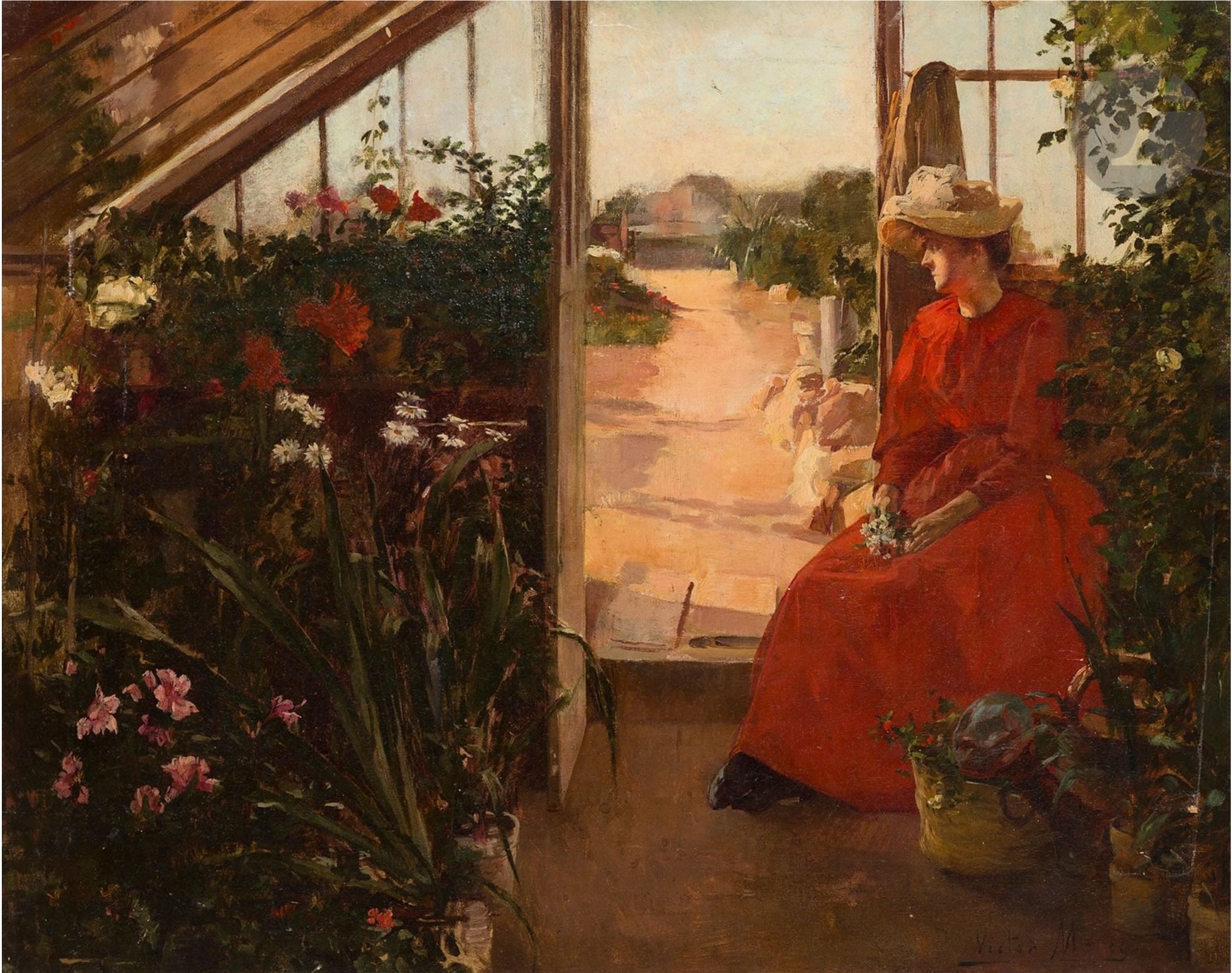
This work depicts an intimate scene within a flowering greenhouse. A woman in a red dress sits at the entrance, bathed in natural light, holding a small bouquet. Marec is known for a distinctive sobriety in his treatment of interior subjects, achieved through the rich tonality of his palette. Though his compositions are often anchored by profound dark tones, they reveal a remarkable tonal spectrum that conveys intimacy and psychological depth.
The floral and botanical details demonstrate exceptional craftsmanship. Each petal is outlined with precise contours and finished with thin glazes that enhance its fragility. The chromatic treatment of leaves and muddy roots is particularly striking: Marec employs varied gestures, brushstrokes, dabs, and stippling to capture the filtering light through foliage and the complex folds of leaves. Despite the prevailing ochre undertones, his palette is surprisingly restrained, composed primarily of deep marine blues, forest greens, and vermillion reds. He applies different touches of red to suggest highlights on flower branches and leaves within shadowed areas, achieving both realism and pictorial richness while maintaining spatial depth. The hot orange-red of vermillion, most visible in the woman's dress, serves as the composition's sensual focal point. Alongside this, Marec employs darker, cherry-toned reds — specifically red lake pigments. He applies streaks of ruby red lake to mark and outline leaf contours, punctuated by quick dabs of turquoise green on the fuller side of each leaf, lending the vegetation a sense of vitality. The composition's lushness and warmth derive from this rich chromatic variance, grounding the scene in heightened realism. Yet it is the inventive manipulation of red that gives the painting its spontaneous luminosity, evoking clear daytime light while preserving the artist's signature dark, enveloping atmosphere.
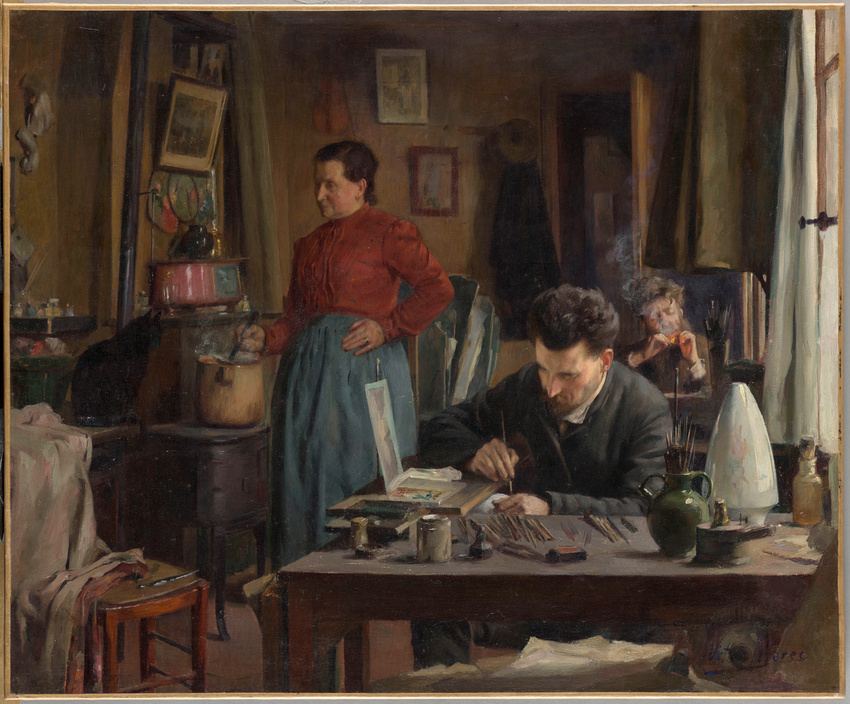
Victor Marec (1862–1920) was a French painter whose work bridges naturalism and post-impressionism. Born Victor Blaise Marrec, he developed a sensitive approach to everyday life, focusing particularly on intimate domestic atmospheres and urban scenes of late nineteenth- and early twentieth-century Paris. His works are held in several prominent Parisian collections. The Musée d'Orsay houses three paintings: The Ceramists, Interior Scene, The Woman in the Mirror, and Portrait of the Artist's Father. The Musée Carnavalet holds Les travaux du métropolitain au Pont Saint-Michel en 1906 (Works of the Metropolitan at Pont Saint-Michel in 1906), among other urban documentation pieces that form an important visual record of Paris's modernisation.
The urban scene and bourgeois everyday theme by Marec Foten served to be collectors’ interests. His paintings chronicle significant infrastructure projects and public events, including the construction of the Paris Métro system. Notable works in this vein include Travaux du métropolitain au Pont-Neuf, en 1899 (Works of the Metropolitan at the Pont-Neuf, 1899), Construction of the New Orléans Station, Quai d'Orsay (1899), Entrée du cloître Saint-Honoré, rue des Bons-Enfants (Entrance of the Saint-Honoré Cloister, Rue des Bons-Enfants), and Fête de nuit, Place de la Nation, à l'occasion de l'inauguration du monument à la République de Dalou, le 19 novembre 1899 (Night Festival, Place de la Nation, for the Inauguration of Dalou's Monument to the Republic, November 19, 1899).



 CN
CN