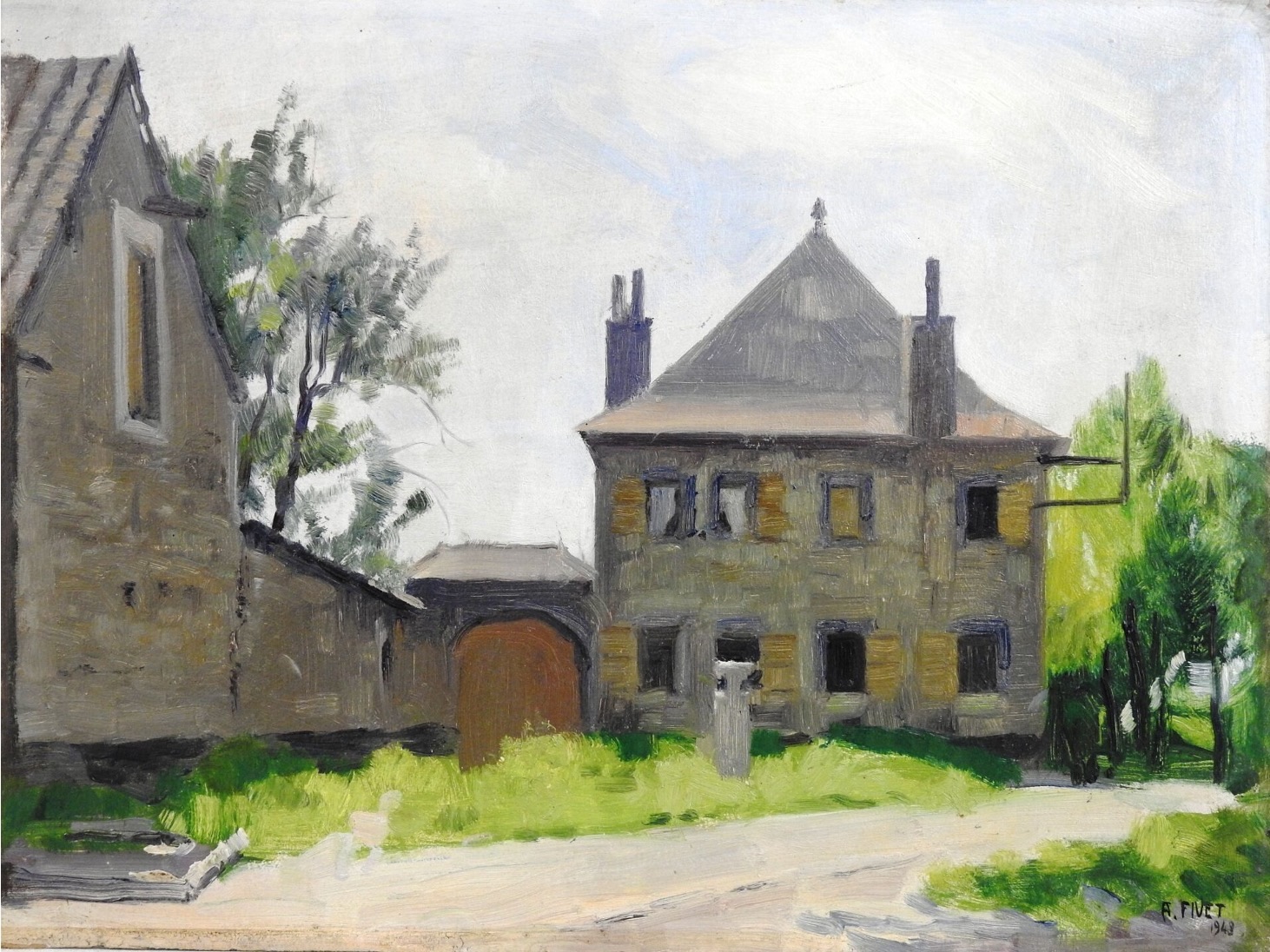
Medium: Oil on cardboard
Dimensions: 30 × 40 cm
Signature: Signed lower right
Period of execution: circa 1948
Price: ¥ 7,000
This work by Alexis Fivet, dated 1948, captures a tranquil French village scene. The composition centres on a stone house with distinctive architecture, its façade accessed by a small path bordered by verdant growth. Diffused light and gentle shadows attest to careful observational practice. Created during the final years of the Liège school's most vigorous period (1880–1950), the painting demonstrates Fivet's characteristic synthesis of Impressionist immediacy and Romantic sensibility.
Fivet's brushwork bears pronounced affinity with Alfred Sisley, the celebrated Impressionist master. His rapid paint application parallels Sisley's approach in The Watering Place at Marly-le-Roi (National Gallery, London). The manner in which Fivet buffs light pigment across sky and pavement echoes the buff-brown ground treatment visible in Sisley's composition. Paint has been applied thinly and swiftly—almost assertively—in response to the plein air ethos central to Impressionist practice. The brushwork remains conspicuously visible, particularly in architectural passages where Fivet relies on paint texture itself to evoke stone masonry's material character. Having sketched the composition with dilute pigment, he built up the scene through layered ochre tones spanning a nuanced spectrum: mauve-inflected yellows, greenish variations. Details were added directly into wet paint with confident immediacy. The feathery brushwork in foliage and tree canopy generates the luminous quality typical of Naturalist concerns, where light itself becomes subject rather than mere illuminating condition.
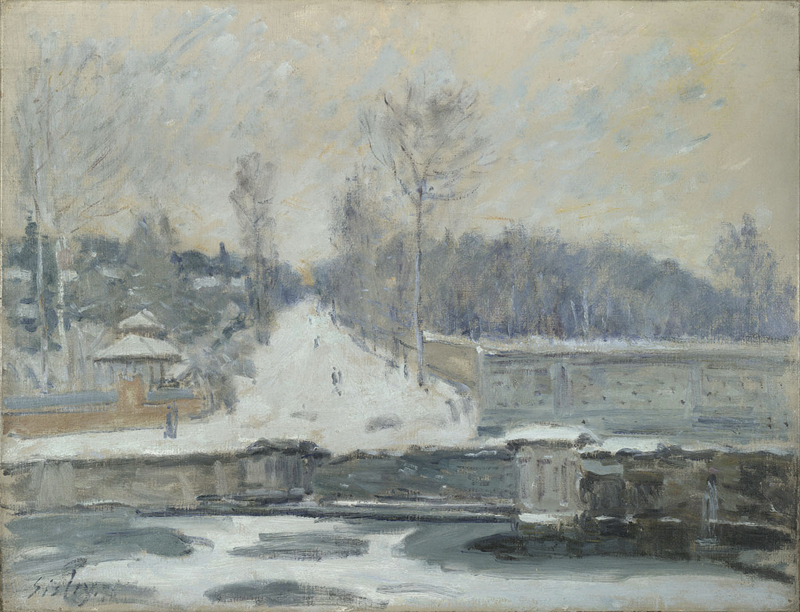
(Fig. 1) Alfred Sisley, , 1875, The Watering Place at Marly-le-Roi, National Gallery, London
Alexis Fivet (1882–1954) was a Belgian artist accomplished in painting, pastel, engraving, and sculpture, notably associated with the Liège school of landscape painting. Liège and its environs emerged as a significant centre for landscape art beginning in the late nineteenth century, a development catalysed decisively by the appointment of Évariste Carpentier as professor at the academy. Under his influence, a cohesive artistic movement coalesced: the Liège school of landscape painting. Fivet's practice emerged during the Liège school's apex, positioning him within a rich tradition of artists who sought to capture the particular character of the Belgian countryside through direct observation and poetic interpretation. His versatility across multiple media—oil, pastel, print, and sculpture—distinguished him within this cohort, allowing him to explore landscape themes through varied technical and expressive means while remaining anchored in the Liège school's foundational commitment to naturalistic observation tempered by aesthetic idealisation.



 CN
CN