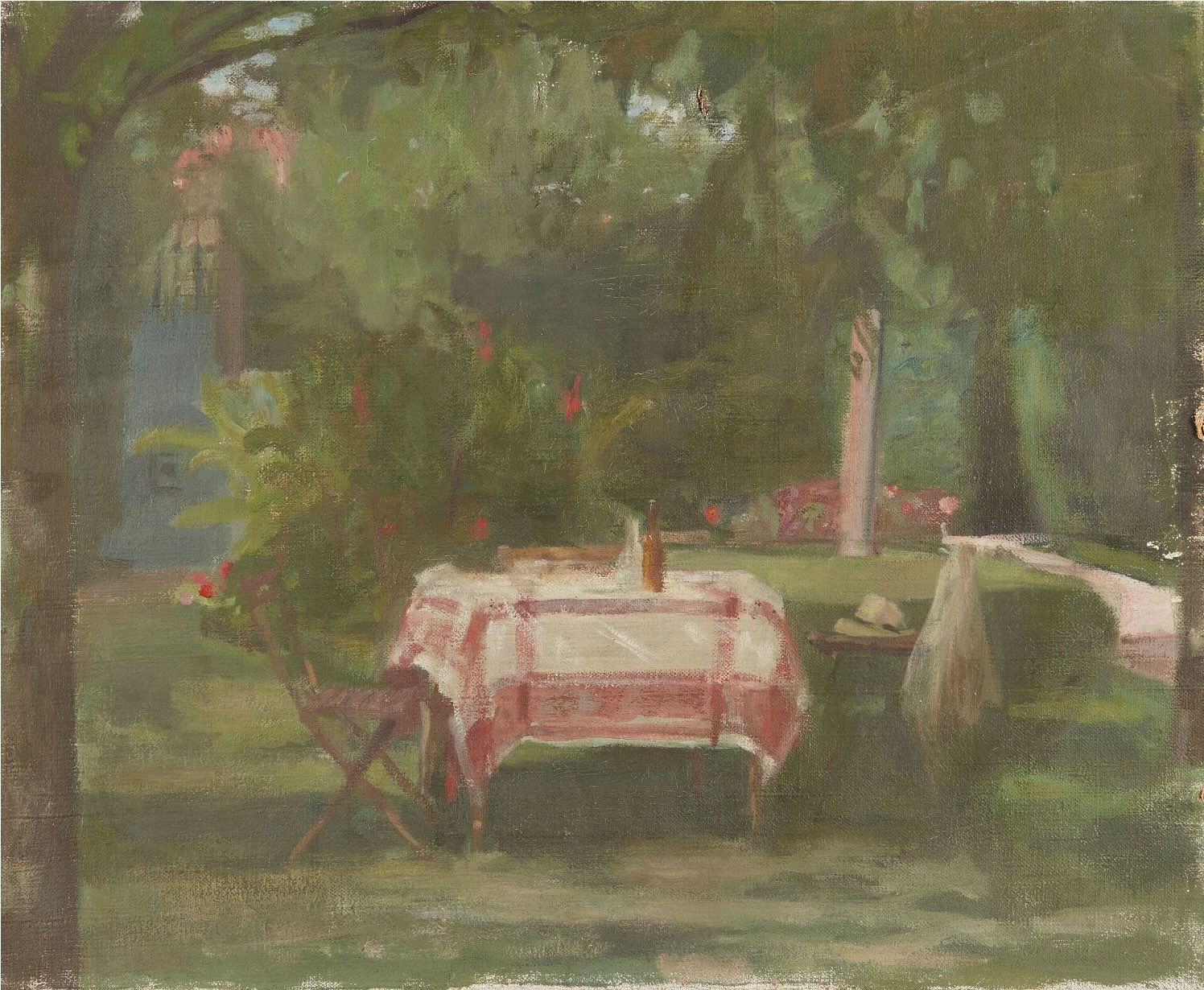
Medium: Oil on canvas
Dimensions: 50 × 61 cm
Signature: Not signed; studio stamped
Period of execution: circa 1946
Price: ¥ 14, 000
This landscape study by Cécile Hertz-Eyrolles pays direct homage to Nabis pioneer Pierre Bonnard, specifically recalling his From the Balcony, Metropolitan Museum of Art (Fig. 1). The painting captures an intimate garden vignette—a corner of a table situated in dappled shade beneath a tree, seemingly observed during a languid French summer. The absence of human presence lends the scene a suspended, almost meditative quality, imbuing it with temporal solitude. Where Bonnard's garden scenes pulse with animated energy, Hertz-Eyrolles seeks something more elusive: the quotidian poetry of domestic life that exists at the periphery of historical memory, often overlooked or eclipsed in traditional narratives of household intimacy.
Picasso famously dismissed Bonnard's palette as "a potpourri of indecision." Yet Hertz-Eyrolles's chromatic approach transcends arbitrary colour arrangement. For her, domestic representation constitutes an investigation into paint's physical properties, the visual rhythms reverberating across the canvas, the dialogue between chromatic notes. Here, she abandons her characteristic turquoise green in favour of a broader spectrum of sylvan tones. These greens, however, are rendered with delicate restraint, their textures modulated by milky undertones that unify the pictorial plane in tranquillity. Nonetheless, within this quietude, she achieves a palpable vitality—the same sense of lived presence that animates Bonnard's work, here reimagined through a distinctly feminine lens of domestic observation.
(Fig.1) Pierre Bonnard, From the Balcony, 1909, The MET, Gallery 962
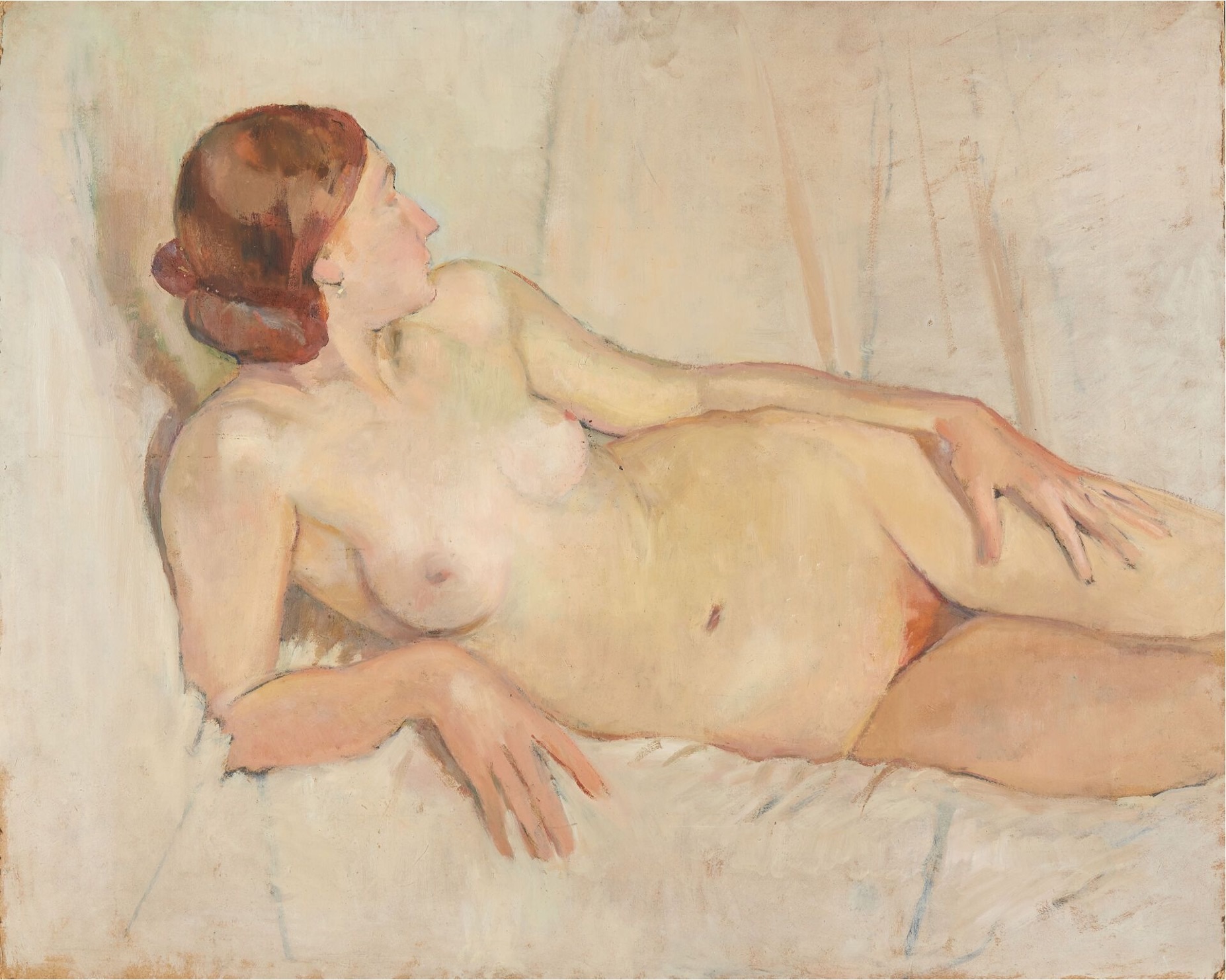
Cécile Hertz-Eyrolles was born on 7 November 1875 into an intellectually inclined family. Demonstrating an early aptitude for the arts, she went on to receive formal training at the Académie Carrière — a remarkable achievement at a time when women faced considerable barriers to professional art education. The academic study of the nude figure, regarded as foundational to artistic development, was considered unsuitable for female students, and institutional routes to training remained largely closed to them. Despite this, Hertz-Eyrolles had the distinction of studying directly under the academy's founder, the Symbolist painter Eugène Carrière. The institution would prove pivotal in modern art history, numbering among its alumni Henri Matisse and André Derain, whose work helped lay the groundwork for Fauvism and left a discernible mark on Picasso's early development.
Her emergence as a professional artist in early twentieth-century Paris carries significance on more than one level. As Linda Nochlin argued in her landmark 1971 essay "Why Have There Been No Great Women Artists?", women had long been systematically excluded from the institutional frameworks — education, patronage, professional recognition — that shaped artistic careers. Hertz-Eyrolles's body of work, therefore, holds value not only on its own aesthetic terms but as part of a broader historical reckoning with whose art has been preserved, exhibited, and taken seriously.
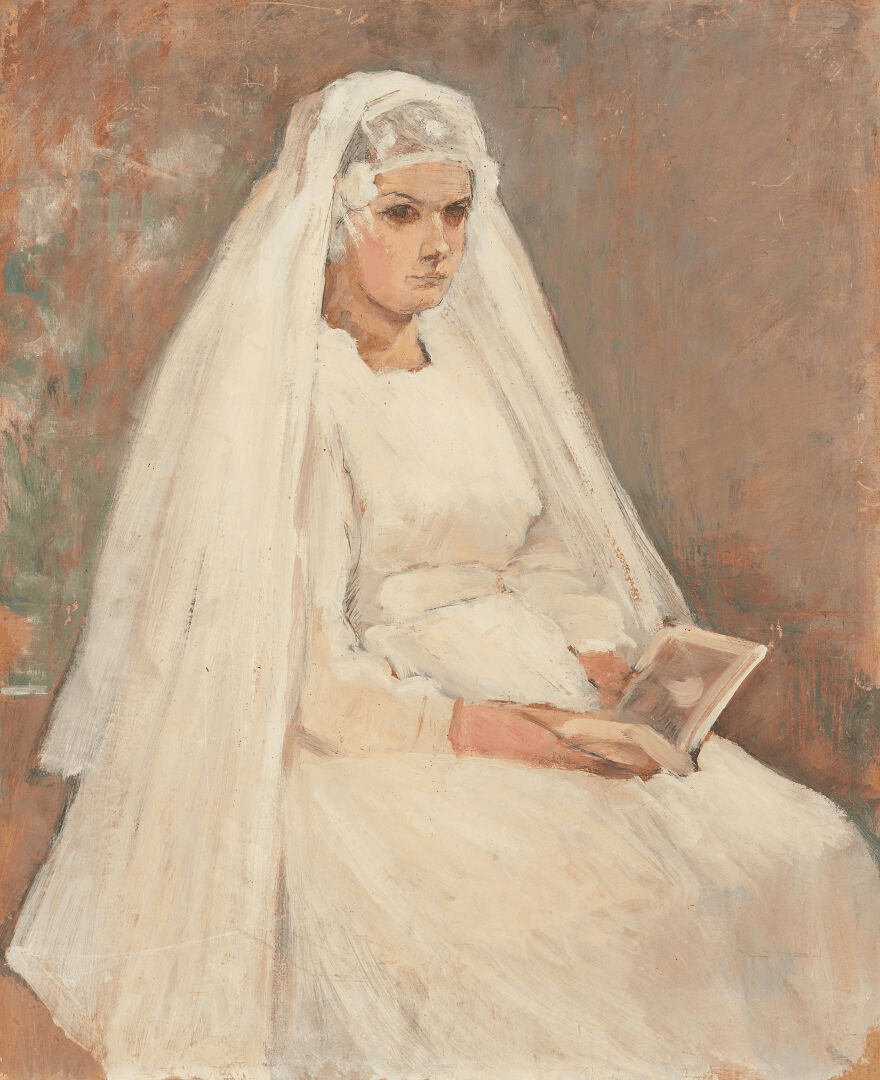
Her paintings gravitate toward the intimate and the everyday: dining rooms, sitting rooms, gardens — spaces that Impressionist painters often treated as incidental backdrop rather than primary subject. Where contemporaries such as Renoir, Édouard Vuillard, and Émile Bernard engaged with domestic interiors, they tended to do so from a position of external observation, rendering family life in terms of soft light, sentimental warmth, and a certain nostalgic femininity projected from without. Hertz-Eyrolles worked differently. Her vantage point was interior — shaped by an inhabiting rather than a visiting perspective — and her canvases reflect this: warm without being idealised, attentive to the quiet fatigue that runs beneath the rhythms of domestic life. Through restrained colour and carefully modulated light, she renders emotional ambivalence and physical presence with a directness that distinguishes her from post-Impressionist contemporaries more preoccupied with visual harmony than psychological truth. Her range extended well beyond the domestic, encompassing landscapes, portraits, maritime scenes, and architectural studies.
Hertz-Eyrolles exhibited regularly at the Salon d'Automne, the Salon National des Beaux-Arts, and the Salon des Artistes Indépendants. In 2024, the city of Cachan held a summer retrospective in her honour. Her works are held in several public collections, among them the Eugène Carrière Museum — an apt resting place for an artist whose career began under that institution's roof.
Reference: Linda Nochlin, "Why Have There Been No Great Women Artists?" in Women, Art and Power and Other Essays (New York: Harper & Row, 1988), 145–178.



 CN
CN