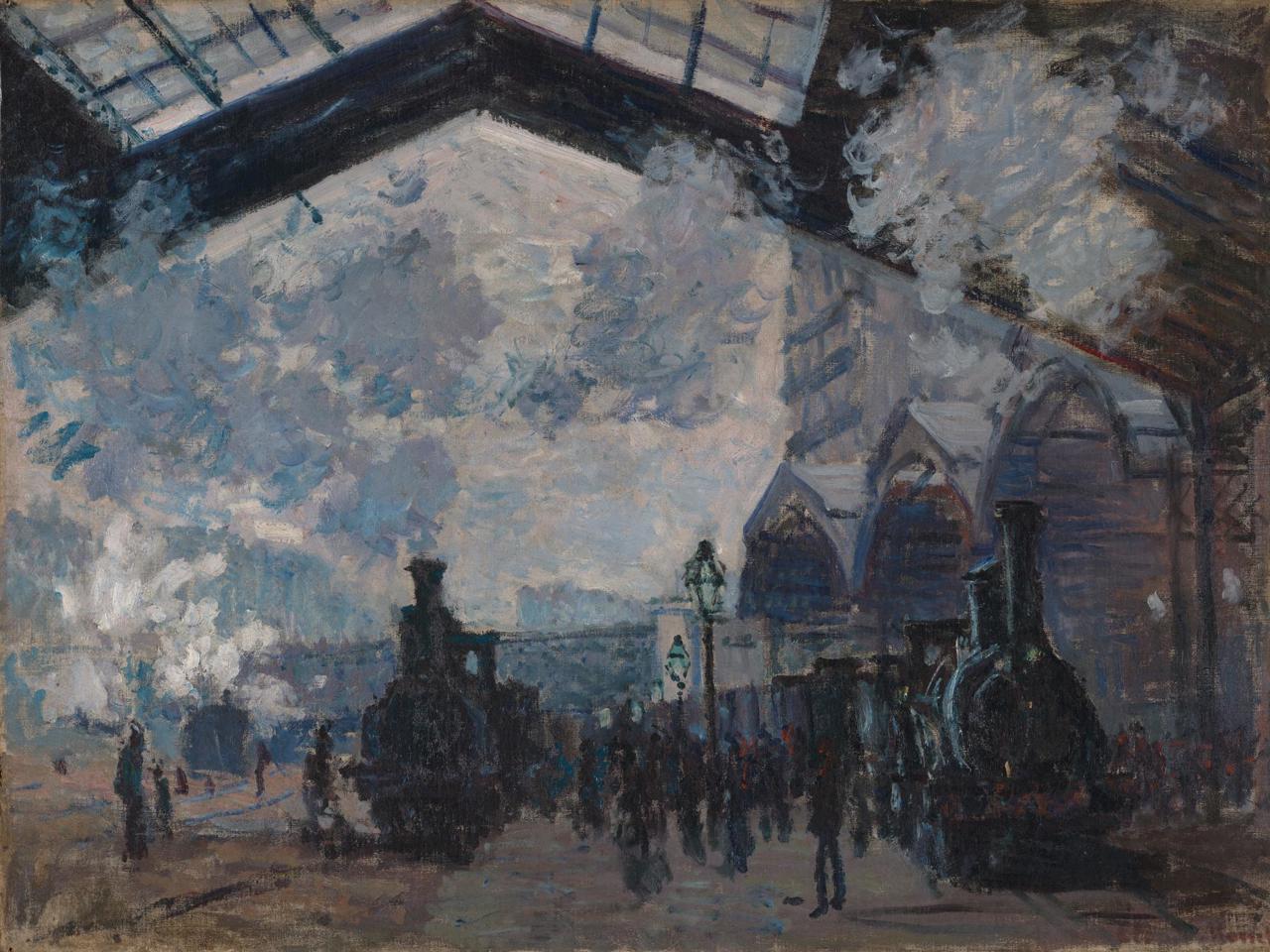
Steam, Vision, System: An Eco-critical Interrogation of Monet’s The Gare Saint-Lazare
In January 1877, Claude Monet secured permission from the Western Railway Company to paint inside the Gare St-Lazare, creating a series of landscape studies that would come to epitomise both Impressionism’s technical achievement and its ideological complicity with industrial modernity. Monet reportedly had trains delayed and locomotives “crammed with coal so they would spew out smoke,” insisting that “the light is better half an hour after departure.”1 This anecdote reveals a fundamental paradox: Monet was not a passive observer within a broader society encountering pollution, but an active participant — indeed, an orchestrator — of the very environmental conditions he aestheticised. His painting operates through what might be termed ‘aesthetic metabolism,’ a process by which industrial degradation is perceptually transformed into consumable optical pleasure.
When painting The Gare St-Lazare, though ostensibly aligned with Impressionism’s en plein air commitment to capturing ephemeral phenomena, Monet moved beyond the passive documentation. Standing on the platform before the terminals of one of the main lines, Monet positions his gaze toward waiting locomotives. Passengers stand poised to board while above, the monumental iron-and-glass canopy frames the composition, containing billowing clouds of vapour from engines below. The interplay between architectural infrastructure’s rigidity and the intangible, ephemeral forms of steam creates a fundamental tension: the geometrical precision of iron girders and framework set against vapour’s transient quality, which Monet captures through energetic and scumbled brushstrokes that dissolve solid form into atmospheric flux. In the middle distance, the low grey mass of the Pont de l'Europe emerges, beneath which white puffs of steam escape into the urban void.
What Monet recorded instead was a material environmental transformation — a process in which iron architecture supplants organic structures and steam becomes a new atmospheric condition, neither wholly natural nor purely technological. In Art and Ecology in the 19th Century, Greg Thomas argues that eco-critical methodology addresses not simply what the artist observes but also interrogates how culture represents and reconstructs nature in “subtle but profound ways.” 2 Similarly, Andrew Patricio insists that eco-critical art history must examine “human/other-than-human boundaries” and the “cultural constructions of nature” that naturalise environmental violence. 3 Monet renders human figures with stippled brushstrokes outlining each bodily silhouette. Their subdued ochre-blue tones fade into the background, suggesting not separation from but participation in industrial ecology. Workers, passengers, and bourgeois travellers alike are implicated in the system that produces the steam they simultaneously inhale. Monet’s impasto captures this ephemerality, diffusing the quality of industrial air as it permeates the scene, thereby serving as an aesthetic mediation of what might be termed the industrial sublime.
1 Renoir, Jean. 1988. in Pierre-Auguste Renoir, mon père (Gallimard), pp. 186-87
2 Thomas, Greg M. 2000. ‘Introduction: The Ecological Paradigm’, in Art and Ecology in Nineteenth-Century France: The Landscapes of Théodore Rousseau (Princeton University Press)
3 Patrizio, Andrew. 2020. ‘Introduction’, in The Ecological Eye: Assembling an Ecocritical Art History (Manchester University Press), p. 17



 CN
CN